An Indian Design Residency Connects Artisans with Milan Design Week
Comments
No comments yet. Be the first to comment.
Loading…
No comments yet. Be the first to comment.
A loom, a stone bench, and a glass furnace are not neutral backdrops for design. They set the scale of a task, make certain gestures possible, and put a designer beside people who know a material through years of handling it. Shakti Design Residency builds its premise around that proximity: international designers spend a month working with Indian ateliers, then bring the resulting objects into public view.
Founded by interior designer Shalini Misra, the annual program held its second cohort in 2026. The finished work was presented at Alcova during Milan Design Week, April 20–26, with first-year resident Duyi Han shaping the exhibition. The event has since concluded. Six designers developed projects with five Indian workshops, spanning stone, textiles, metal, glass, and cane.
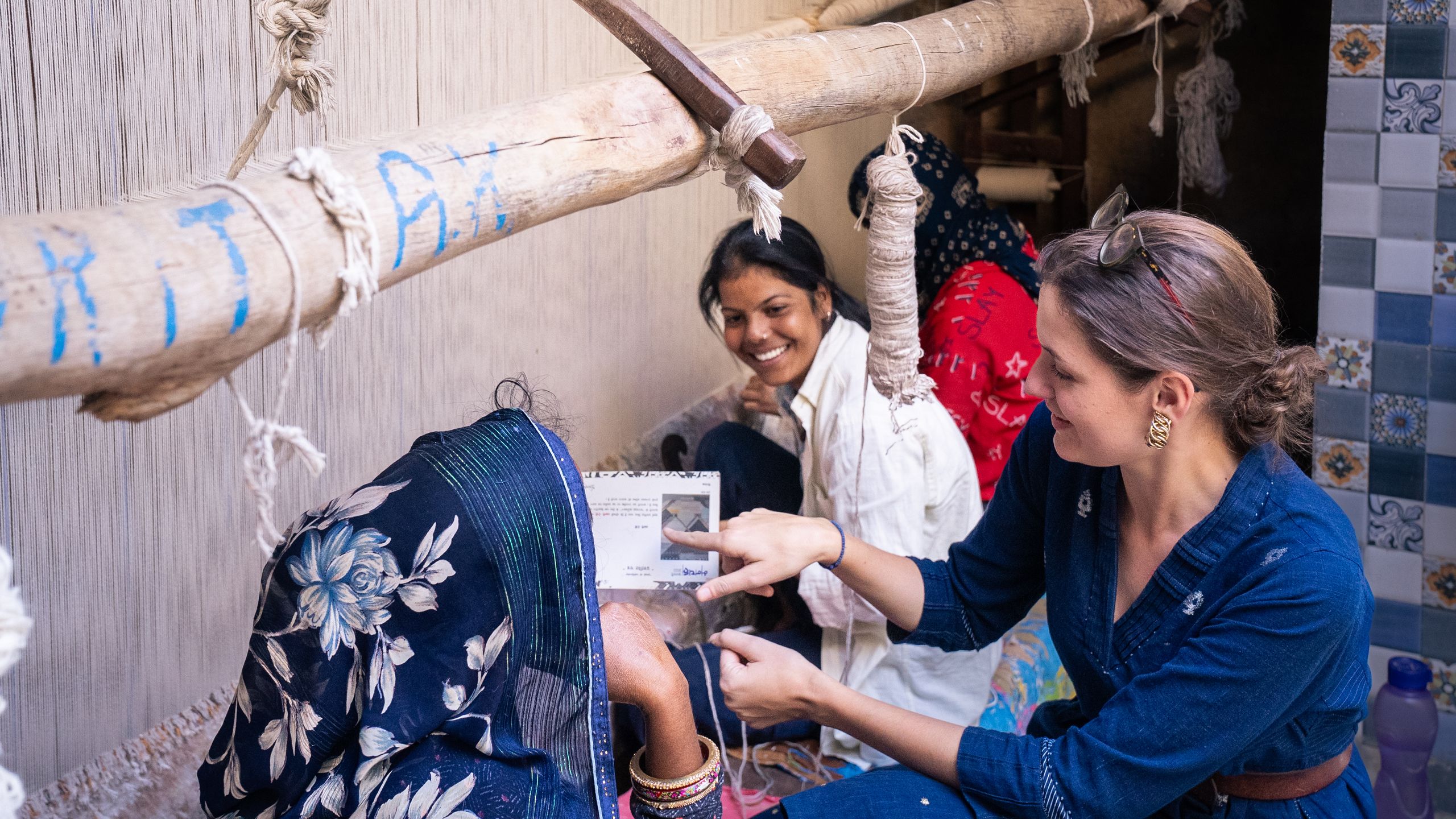
At Jaipur Rugs, a designer and a workshop collaborator look closely at a woven sample beneath the loom’s heavy wooden crossbar. The sample is held between them, so the conversation is literally about a piece of cloth: its color, pattern, and surface at hand. That kind of shared inspection is a different starting point from choosing a material from a catalogue. Victoire de Brantes’s project drew on wool and locally sourced Rajasthani pigments, using the rug as a field for color and landscape.
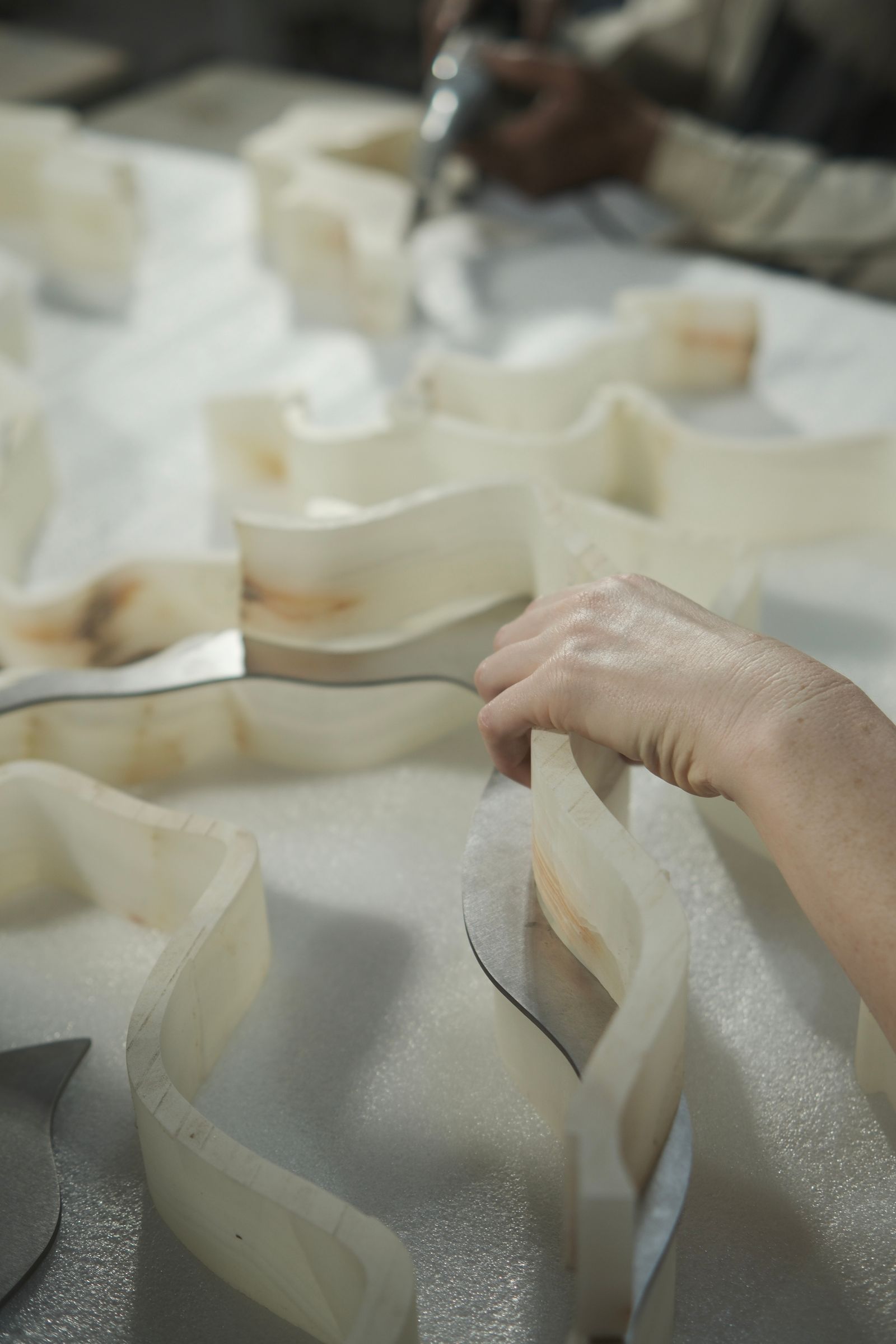
At Frozen Music, outside Jaipur, Zofia Sobolewska Ursic worked with the atelier’s technicians to cut white onyx into narrow ribbons for a cabinet. The photograph crops close to the hand and stone, and the pale strips curl like paper even as their edges retain the density of a mineral. That visual contradiction is the project’s central design problem: how to make a hard, heavy material read as light. It also reveals why the workshop matters to the object. Thin stone elements demand a degree of control that is difficult to achieve without the right equipment and practiced hands. The cabinet’s apparent delicacy is therefore not a surface effect added after construction; it depends on the way the stone is worked.
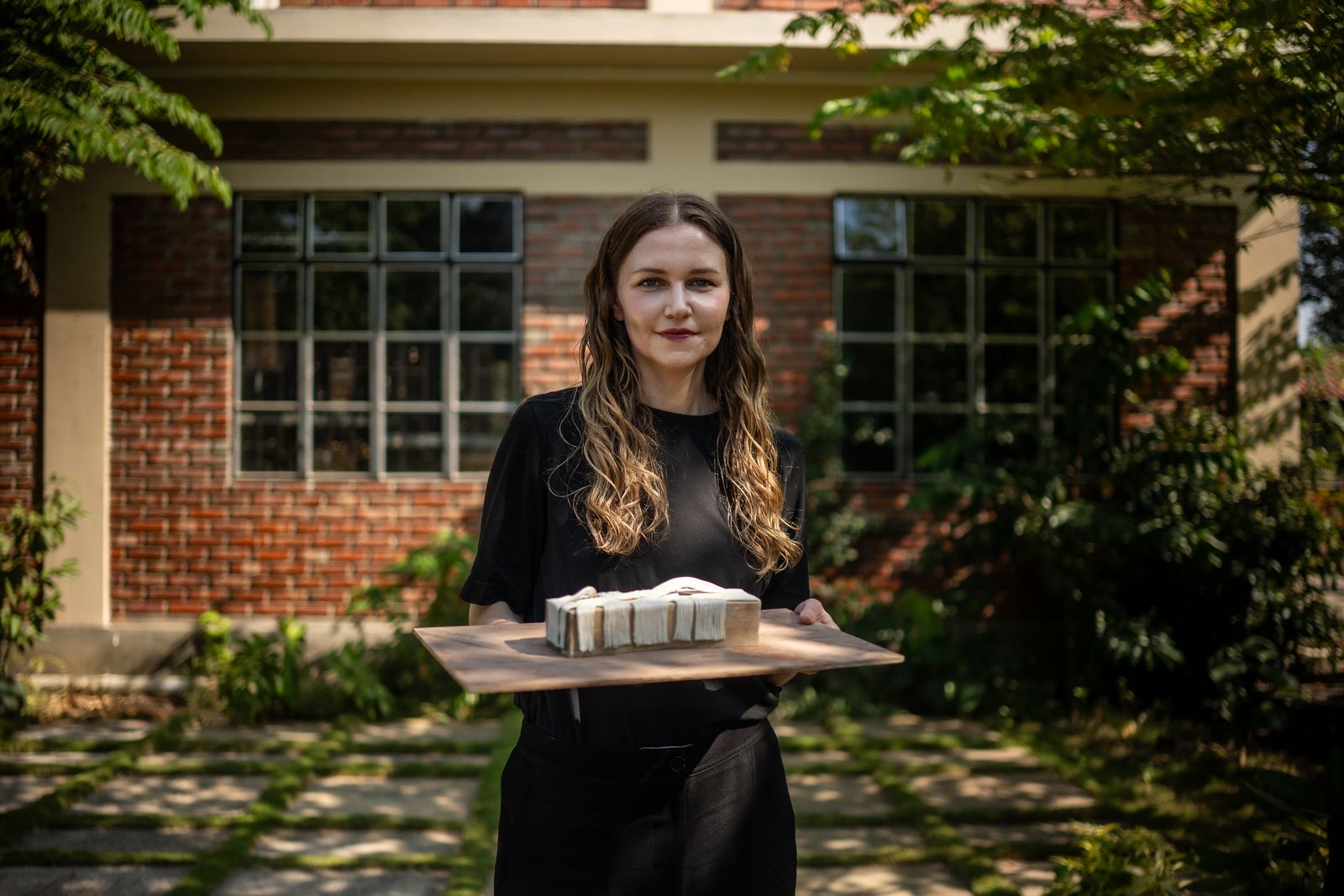
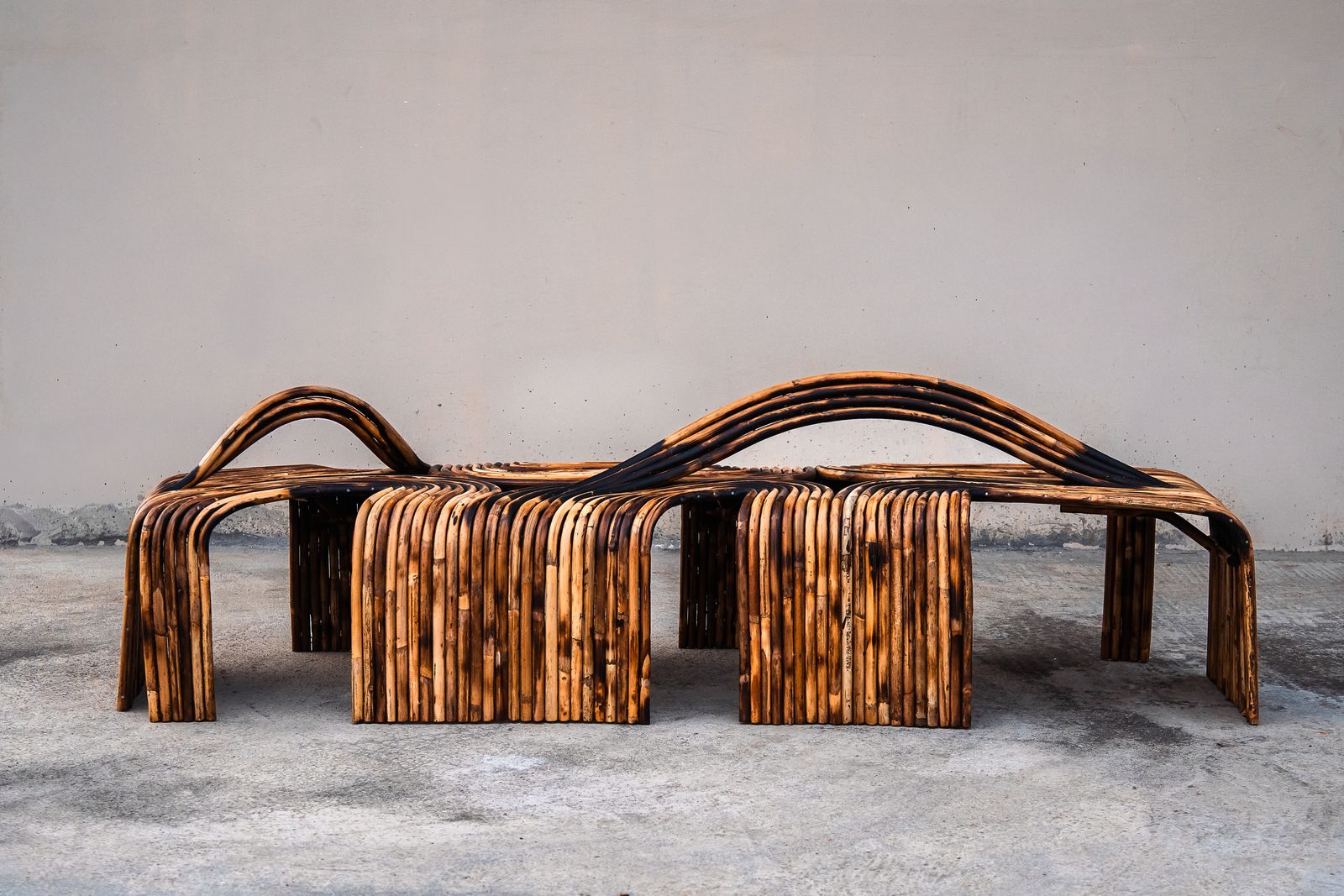
The pairing with Heirloom Naga Centre starts from a different relationship between material and form. A portrait of Maria Tyakina shows her holding a compact prototype with repeated ridges and a softly irregular outline. Beside it, the finished cane piece stretches those ideas across a much larger horizontal span. Thick bent members rise into low arches and descend into a closely spaced series of verticals; the loops read at once as a surface and as a support. The furniture keeps the material’s linear quality visible, rather than hiding its structure behind a solid shell. Tyakina and Tadeáš Podracký each worked with the centre, and their projects drew on cane-working techniques from Nagaland.
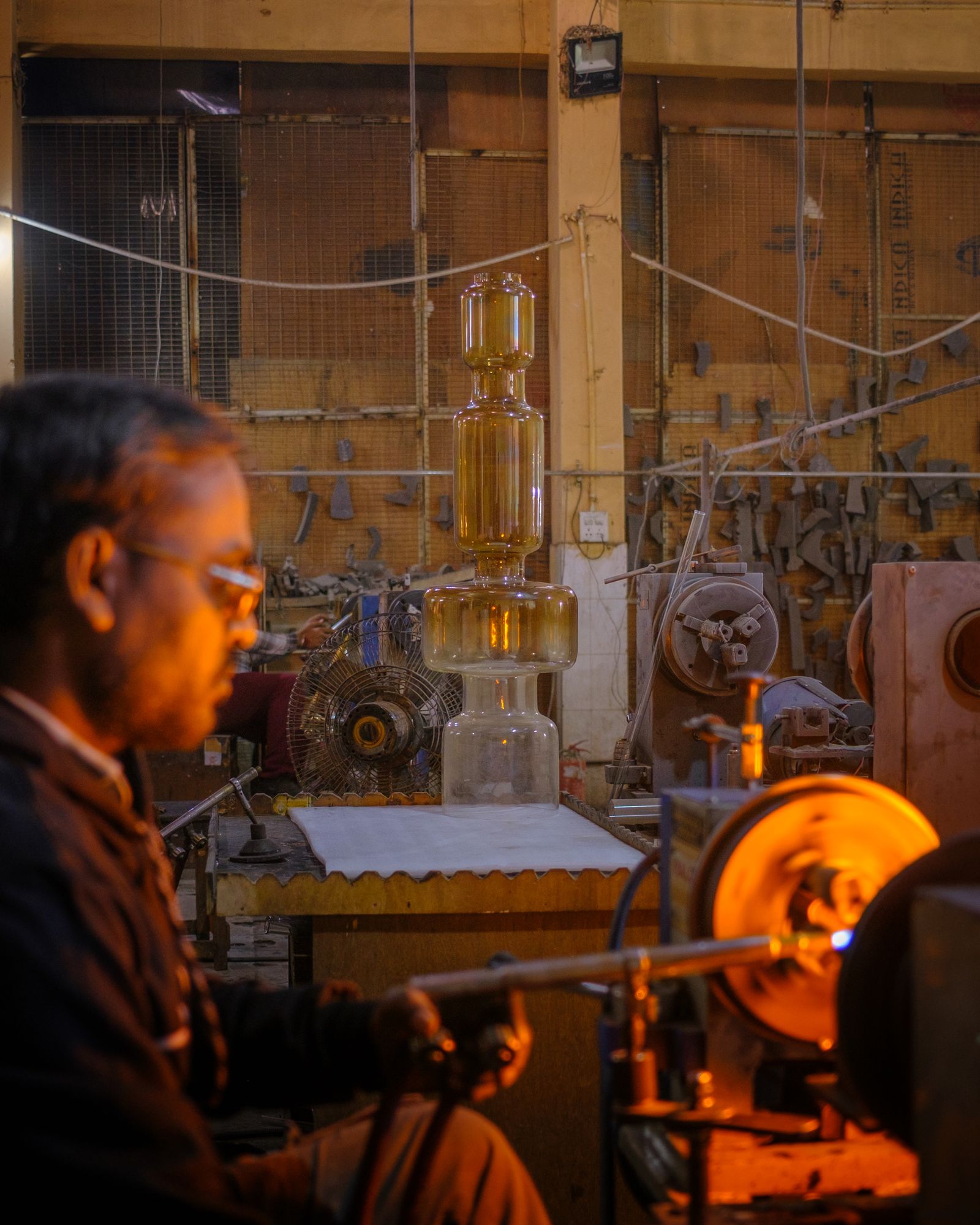
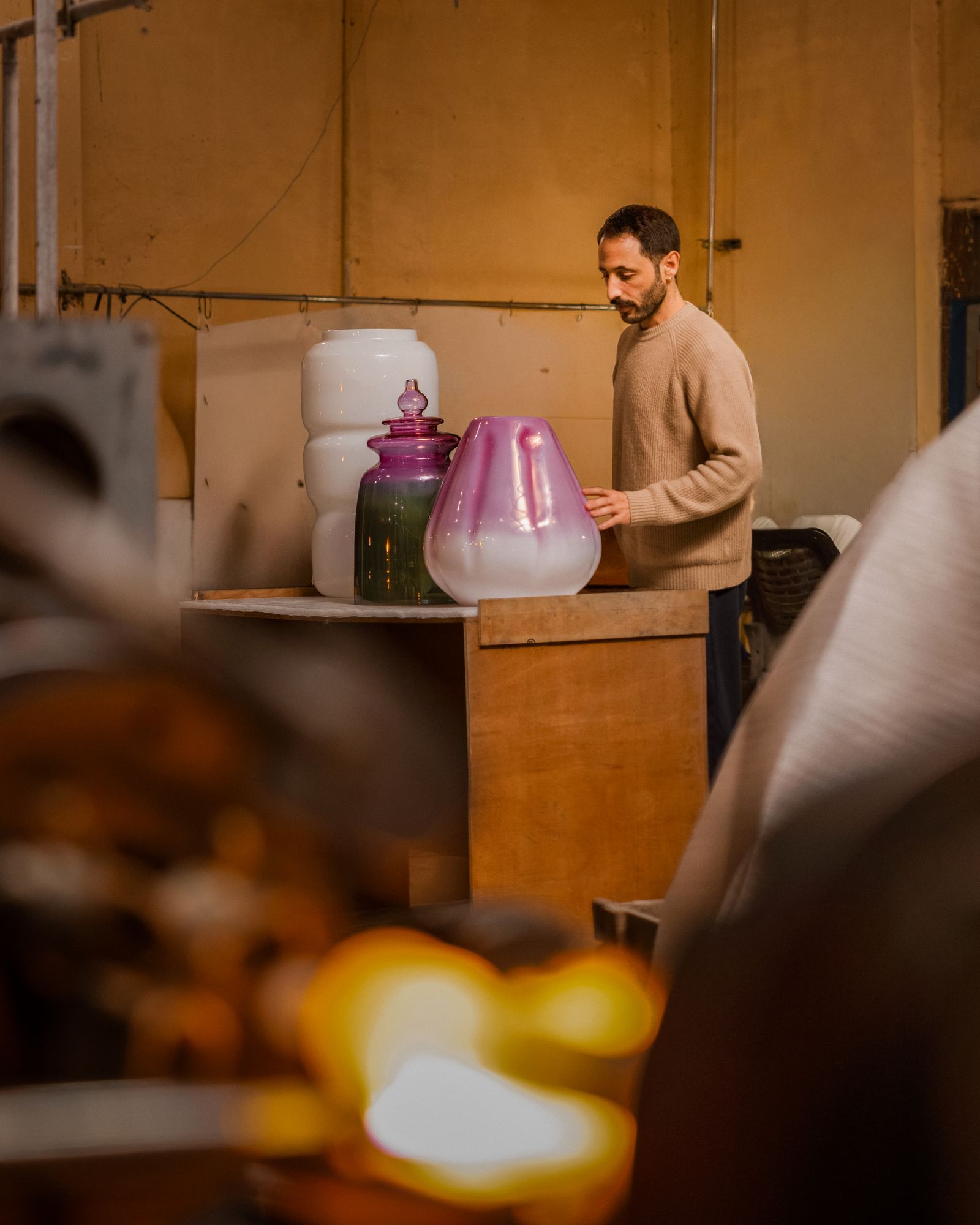
Glass gives the program another way to bring process into view. Daniel Garber worked with Klove Studio on lighting informed by early Indian glassmaking traditions. In the workshop photograph, an amber glass form stands upright amid tools, machinery, and the warm glow of the furnace. A second image places Garber beside several large, colored forms, their translucent bodies and rounded shoulders arranged like a small family. The scale matters: these are not tiny decorative accents but substantial volumes, and their color shifts with the light passing through them. The workshop setting makes the labor behind that finish legible, while the objects themselves keep the focus on silhouette and light.
The other projects broaden the material range. Rodolfo Agrella developed a suspended mobile in hammered brass with Vikram Goyal Studio, while the Jaipur Rugs collaboration brought wool and regional pigments into a woven composition. Taken together, the work resists a fixed picture of what craft-led design should look like. Stone becomes an exercise in apparent lightness, cane becomes a structural drawing in space, and glass turns color and volume into the primary experience of a lamp.
A month in a workshop cannot answer every question about the longer life of a collaboration. The exhibition does something more specific: it gives each project a public setting in which an atelier’s material knowledge can be read alongside a designer’s formal decisions. In the onyx cabinet, for example, the delicacy is legible only because the stone has been cut with unusual precision; in the cane furniture, the repeated bends carry both structure and pattern. Shakti’s clearest proposition is visible in those objects: contemporary forms can emerge from a working relationship with a material and the people who understand it, rather than from a decorative reference to craft.
Seen as a sequence, the images move between action and result. The close crop at Frozen Music records a hand working the stone; Tyakina’s portrait connects a small prototype to the cane form shown at full scale. The glass views keep the objects within the workshop, first amid equipment and then beside Garber. The photographs do not document every stage, but they make one part of the residency’s method visible: a material is handled, tested, and carried into a finished object, rather than appearing only as a reference in the final presentation.